 openaccessexchange@gmail.com
 Mon - Fri: 9 AM to 8 PM


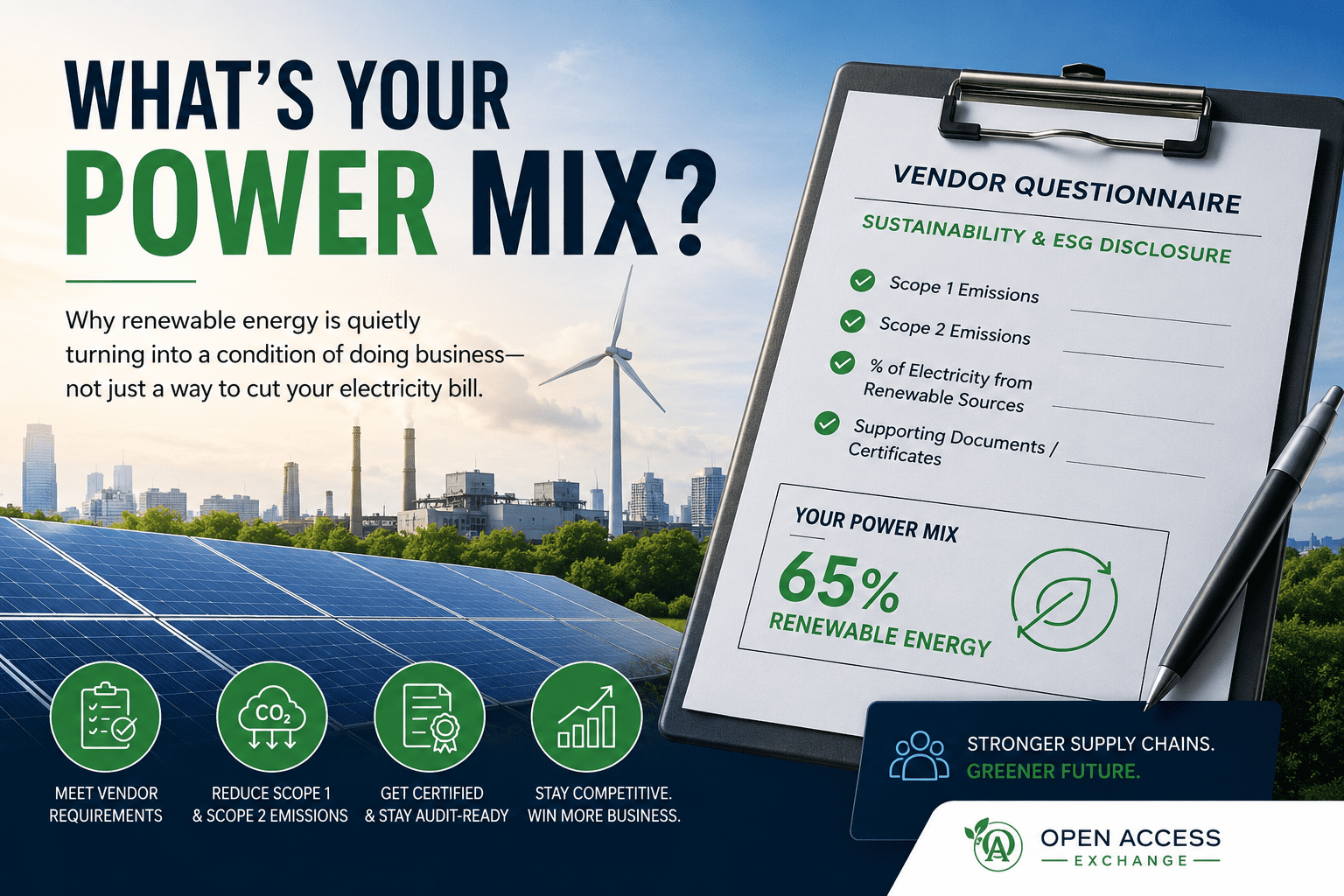
The New Question on Your Customer's Vendor Form: "What's Your Power Mix?"
A few months ago, this would have sounded like a strange thing to put in a vendor empanelment form. Today, it’s becoming routine.
If you supply to a large listed company — an auto OEM, an FMCG major, a pharma giant, a chemicals or speciality manufacturer — there’s a good chance someone in their sustainability or procurement team has already emailed you, or will soon, asking for:
- Your facility’s Scope 1 and Scope 2 emissions
- What percentage of your electricity comes from renewable sources
- Documentation or certificates to back up that number
Most business owners read that email, shrug, and forward it to whoever handles “the green stuff.” That’s a mistake. This isn’t a green stuff request. It’s becoming a commercial one.
What’s actually driving this
In 2023, SEBI introduced BRSR Core — a set of mandatory ESG disclosures for India’s top listed companies, covering nine attributes including energy use and greenhouse gas emissions. The rollout is phased: top 150 companies from FY 2023-24, expanding to the top 250, then top 500, and the top 1,000 by FY 2026-27.
Here’s the part that matters to you even if your company isn’t listed: SEBI’s framework also covers the value chain — meaning a listed company’s major suppliers and customers, specifically those accounting for 2% or more of its purchases or sales individually, and 75% of that value collectively. SEBI eased this from mandatory to voluntary in early 2025, giving companies more breathing room. But the direction hasn’t changed — large buyers are still building these systems, because the pressure isn’t only coming from SEBI.
It’s coming from their own customers and investors too. A multinational FMCG or auto parent with a global net-zero commitment doesn’t wait for an Indian regulator’s timeline — it pushes decarbonization expectations down through its own supply chain on its own schedule. Many already use third-party platforms like EcoVadis or CDP to score suppliers on exactly this. If you sell into that chain, the questionnaire eventually reaches you, regardless of what SEBI mandates this year.
Why this lands on you specifically
If you run a mid-size manufacturing unit — components, packaging, intermediates, contract manufacturing, ancillary supply — you might assume this is a “big company problem.” It isn’t. It’s a trickle-down problem, and it tends to show up in three very practical ways:
1. Vendor scorecards start including a sustainability column. Pricing, quality, and delivery used to be the whole scorecard. Increasingly, there’s a fourth column — and if you have no data to put there, you don’t get a low score, you get a blank, which often scores worse than a mediocre number. reels video downloader for instagram
2. Tenders start asking for it upfront. Some RFQs now include a line item for emissions data or renewable energy share as a qualifying criterion, not a bonus one. instagram reel video download online
3. Existing contracts get re-evaluated, not just new ones. A buyer consolidating its supplier base for ESG reasons isn’t only screening new vendors — it’s looking at who to keep. save instagram reels online
None of this shows up as a dramatic event. It shows up as quietly losing ground to a competitor who had an answer ready when you didn’t.
Why your power mix is the fastest lever you have
Of the nine BRSR Core attributes, energy and GHG emissions are usually the two a manufacturer can move fastest — because for most industrial units, electricity is the single largest controllable input to Scope 1 and Scope 2 emissions. You can’t redesign your supply chain or change your workforce composition overnight. You can change where your power comes from.
This is also where the renewable energy conversation looks different from the “switch to solar and save money” pitch you’ve probably already heard a dozen times. The savings are real and worth having — but for a business answering to a customer’s sustainability audit, the more valuable thing isn’t the rupees saved. It’s the number you can now put on a form, backed by a certificate.
Whether that’s through: Instagram reels downloader no watermark
- Open Access power procurement (buying renewable electricity directly from a generator instead of only the grid)
- Group Captive participation (co-owning a renewable asset with other consumers)
- On-site rooftop solar (CAPEX or zero-investment OPEX models) Instagram reels mp4 download
— each of these comes with documentation: generation certificates, power purchase records, metering data. That paper trail is exactly what an auditor or a customer’s ESG team wants to see. It’s the difference between writing “we’re committed to sustainability” in a tender response and attaching an actual number with proof behind it. download Instagram reels in 1080p
From defensive to advantage
There are two ways to approach this. One is defensive: scramble to get a renewable energy percentage in place right before a customer audit, treating it like a compliance fire drill. The other is to treat it as a genuine differentiator — getting your power mix sorted before it’s asked for, so that when the vendor questionnaire lands, you’re the supplier with a clean answer already on file, while others are still figuring out what Scope 2 even means. reels video downloader
In a market where buyers are actively trying to shrink and “clean up” their supplier base, being the vendor who makes their ESG reporting easier is a quiet but real competitive edge — on top of the electricity savings you’d get anyway. reels downloader for Iphone
Where to start
You don’t need to overhaul your entire energy setup to answer this question credibly. Most businesses start with a simple exercise: get an assessment of your current load, your eligibility for Open Access or Group Captive models, and a realistic estimate of what percentage of your consumption you could shift to renewable sources over the next 12–24 months. That number — even a partial one, with documentation — is usually enough to move you from “no answer” to “credible answer” on most vendor forms. Instagram reels downloader HD
If a customer’s sustainability questionnaire has already landed in your inbox, or you suspect one is coming, the right time to get that number sorted was a few months ago. The next best time is now. download Instagram reels in HD