 openaccessexchange@gmail.com
 Mon - Fri: 9 AM to 8 PM


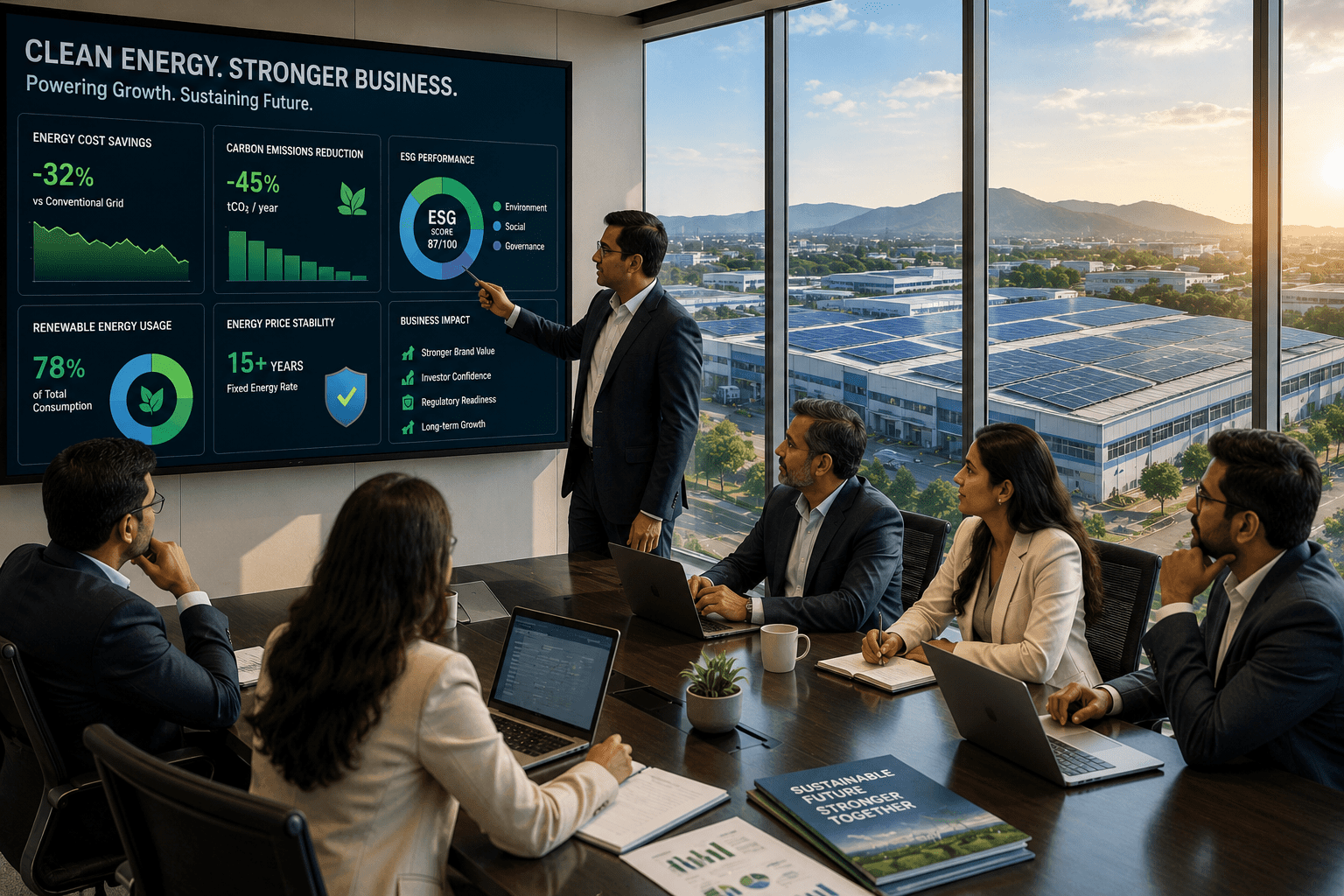
Clean Energy Is No Longer Just About Saving Money — It's About Building a Stronger Business
There’s a conversation happening in Indian boardrooms right now that would have sounded unusual five years ago. It’s not about how much a business can save by switching to solar. It’s about how much stronger the business becomes when it does.
That shift in framing — from cost reduction to competitive advantage — is one of the most significant changes in how India’s business community thinks about clean energy. And understanding it is the difference between treating renewable power as a procurement decision and recognising it for what it has actually become: a strategic asset. spotifydown
The Question Has Changed
For a long time, the conversation around clean energy for businesses started and ended with the electricity bill. How much are you paying per unit? How much could you save? What’s the payback period? These are legitimate questions, and the answers are compelling — businesses adopting Open Access solar are regularly reducing their power costs by 20 to 40 percent, locking in stable tariffs for 15 to 25 years, and freeing up capital that was previously disappearing into unpredictable grid charges.
But the more interesting question — the one that forward-thinking business owners across India are now asking — is a different one entirely. It’s not “how much can we save?” It’s “how much stronger can we become?”
Because it turns out that the decision to move to clean energy doesn’t just change your electricity bill. It changes your business.
What Clean Energy Actually Does to Your Brand
Think about the businesses in India that are winning the most respect right now — from customers, from partners, from the talent they’re trying to attract. Sustainability is not an afterthought in how those businesses present themselves. It is central to their identity. And it is backed by real, measurable action — not just a page on their website about environmental values.
When your business runs on renewable energy, that is not a small thing. It is verifiable proof that your organisation is operating responsibly. For customers who are increasingly making purchase and partnership decisions based on values as much as price, that matters. For global buyers who are asking for carbon credentials before they sign procurement contracts, that matters enormously. And for the generation of talented professionals entering the workforce today — many of whom actively choose employers based on their environmental commitments — it matters more than most business owners currently realise.
Clean energy, in short, is becoming a brand asset. One that is growing in value every year as sustainability moves further from the margins to the mainstream of business decision-making in India and globally.
What It Does to Your Relationship With Investors
The investment community’s relationship with ESG — Environmental, Social, and Governance standards — has moved from polite interest to genuine scrutiny. Institutional investors, private equity firms, and international funding partners are now conducting detailed assessments of the sustainability performance of the businesses they back or consider backing.
A business that can demonstrate a real, documented commitment to clean energy — with actual data on emissions reduced, renewable units consumed, and carbon targets being met — presents a fundamentally different risk and opportunity profile than one that cannot. It signals operational discipline. It signals long-term thinking. And increasingly, it signals access to a growing pool of green financing that carries better terms than conventional debt.
For Indian businesses with ambitions to scale, attract foreign investment, or eventually access public markets, the ESG story is no longer optional background material. It is front-and-centre due diligence. Clean energy adoption is one of the most credible and measurable contributions a business can make to that story.
Predictability Is Its Own Competitive Advantage
Here is something that doesn’t get discussed enough when businesses evaluate clean energy. Beyond the savings and the sustainability credentials, there is a quieter but equally powerful benefit: the ability to plan with confidence.
Every business that is currently dependent on conventional grid power is exposed to a risk that is easy to underestimate — tariff uncertainty. Grid electricity prices in India have risen consistently over the past decade, and they will continue to do so. Every year that passes, the gap between what you’re paying and what you budgeted grows a little wider. That unpredictability flows through into every financial model, every pricing decision, and every investment case your business builds.
An Open Access solar agreement locks your energy rate for the life of the contract. Your cost of power in year fifteen is the same as it was in year one. In a business environment where very few input costs offer that kind of stability, predictable energy pricing is genuinely valuable — and the businesses that have it operate with a planning confidence that their grid-dependent competitors simply don’t have.
Sustainability Is Now a Measurable Return on Investment
The framing of sustainability as a cost — something you spend on because you should, rather than because it pays — is one of the most persistent and damaging misconceptions in Indian business today. The reality, in 2025, is that for most large industrial and commercial consumers, the decision to adopt clean energy through Open Access is a decision with a clear, calculable, and favourable return.
Lower operating costs. Stable energy pricing. Reduced carbon exposure. Stronger brand positioning. Improved investor relations. Better talent attraction. The ability to meet Renewable Purchase Obligations without penalties. Each of these has a value that can be measured and attributed directly to the clean energy decision. Together, they add up to something considerably more compelling than a simple electricity bill saving.
Sustainability is not an expense. It is an investment — and increasingly, it is one of the best-returning investments a business can make.
The Companies That Understand This Are Already Moving
Across India’s industrial and commercial landscape, the businesses that have grasped this shift are not waiting for perfect conditions or complete regulatory certainty. They are moving because they understand that the competitive advantage of acting early compounds over time, while the cost of waiting grows with every passing year.
They are signing Open Access agreements that lock in energy rates their competitors will eventually wish they had secured. They are publishing sustainability reports that are opening doors with global partners. They are building brands that resonate with customers, investors, and employees in ways that their conventional-energy counterparts cannot match. And they are doing all of this while running more cost-efficient operations than the businesses standing still.
The future, as it turns out, belongs to the companies that understand worth — not just watts.
This Is What Open Access Exchange Was Built For
At Open Access Exchange, we exist for exactly this moment — when Indian businesses are ready to move beyond thinking about clean energy as a utility decision and start treating it as the strategic business decision it has become.
We bring together the tools, the expertise, and the market access that businesses need to make that transition with confidence. From understanding your current energy profile to identifying the right open access solution, navigating the approval process, and managing your energy performance over time — we make clean energy adoption simple, transparent, and genuinely transformative.
Because the businesses that will define India’s next decade of industrial growth are the ones making smart, forward-looking decisions today. And there are very few decisions as smart, or as forward-looking, as the one to build your business on clean energy.
Let’s start that conversation. Reach out to Open Access Exchange today.