 openaccessexchange@gmail.com
 Mon - Fri: 9 AM to 8 PM


Why Grid Flexibility, Battery Storage and Connectivity Matter ?
India has made remarkable progress in expanding renewable-energy capacity, particularly solar power. But as renewable generation reaches a larger share of the electricity system, a new challenge is becoming increasingly important: how to integrate more renewable power without wasting the electricity generated.
A recent analysis by Ember argues that India’s power system is approaching a flexibility constraint. Solar and wind now contribute a significant share of electricity generation, with their contribution becoming particularly high during midday solar-production hours. At the same time, coal remains the dominant source of system flexibility.
The result is a growing mismatch between India’s rapidly expanding renewable fleet and the flexibility available to balance it.
Solar Is Changing How India’s Grid Operates
India’s renewable-energy system is increasingly characterised by two different operating periods.
During the day, solar generation can become a major component of electricity supply. After sunset, solar generation falls rapidly while electricity demand continues.
This creates a daily requirement for the rest of the power system to adjust around renewable generation.
Ember’s analysis highlights the scale of this transition. Solar and wind accounted for around 14.4% of India’s electricity generation in 2025, while their share can become significantly higher during peak renewable-generation periods.
As solar capacity increases, conventional generators must increasingly reduce output during periods of high solar generation and then increase output again as solar production declines.
That makes flexibility just as important as generation capacity.
Coal Flexibility Is Reaching Its Limits
Coal continues to play a central role in India’s electricity system and currently provides much of the balancing flexibility required to respond to changing supply and demand.
However, coal plants cannot reduce generation indefinitely.
They have minimum technical operating levels below which stable operation becomes difficult or impossible.
According to Ember’s analysis, India’s coal fleet is increasingly being pushed toward these operating limits during periods of high renewable generation. Once coal generation reaches those limits, there is less room for further downward adjustment.
At that point, renewable generation itself may have to be reduced.
This creates an important paradox:
India can have abundant renewable electricity available while simultaneously curtailing some of that clean power because the rest of the electricity system cannot flex enough to absorb it.
Ember estimates that coal minimum technical-load constraints created around 2.1 TWh of renewable-curtailment risk in FY2025–26, equivalent to approximately 1.3% of total renewable generation and about ₹629 crore of foregone electricity. These figures are Ember’s estimates and reflect its methodology.
Curtailment Could Become a Bigger Issue
Renewable curtailment is not necessarily caused by one factor.
Transmission congestion, demand patterns, forecasting errors, reserve requirements and regional system constraints can all contribute.
However, Ember’s analysis focuses specifically on the interaction between renewable generation and the technical operating limits of coal generation.
The report estimates that during some constrained midday periods, around 5–6% of solar and wind generation could be displaced because thermal generation cannot reduce output sufficiently.
If renewable capacity continues to expand faster than flexibility resources, the amount of clean electricity that cannot be fully utilised could increase.
This makes the next phase of India’s energy transition fundamentally different from the previous one.
The challenge is no longer simply:
How quickly can India build renewable capacity?
It is increasingly:
How effectively can India integrate and utilise that capacity?
Battery Storage Could Become the Missing Flexibility Layer
This is where Battery Energy Storage Systems, or BESS, become increasingly important.
A battery can charge when renewable generation is abundant and discharge when electricity is required.
During high-solar periods, BESS can absorb surplus electricity that might otherwise be curtailed.
Later, the stored electricity can be supplied during evening demand peaks or other periods when renewable generation is lower.
But storage can provide more than energy shifting.
It can also provide downward flexibility.
When coal generation has already reached its minimum operating level, a battery can continue absorbing electricity from the system, reducing the need to curtail renewable generation.
Ember estimates that around 10 GWh of storage charging during the midday window could have been sufficient to absorb a significant portion of the surplus associated with the constraints it analysed.
India’s BESS Deployment Is Accelerating
Importantly, the report does not identify battery technology itself as the primary bottleneck.
India has already demonstrated that large-scale BESS projects can be deployed relatively quickly.
Ember highlights projects including the 20 MW/40 MWh Kilokari BESS in Delhi and the 3.37 GWh Khavda BESS project in Gujarat as examples of India’s growing deployment capability.
This suggests that the challenge is increasingly shifting from whether batteries can be built to how effectively they can be connected and operated within India’s electricity system.
Connectivity Rules Matter
One of Ember’s central arguments concerns the regulatory framework governing grid access for storage.
The report argues that BESS should be able to charge from the grid during periods of renewable-energy surplus.
This is important because surplus renewable electricity may not always originate from the same renewable project or location as the battery.
A system-wide battery that can respond to grid conditions can potentially absorb electricity wherever the system has excess supply.
In Ember’s view, restrictions that effectively tie storage operation too closely to co-located renewable generation could reduce the flexibility that BESS can provide.
The report therefore calls for a more targeted approach to connectivity: constrain battery drawal where genuine network risks exist, but allow charging when it helps reduce renewable curtailment and system stress.
Storage Is Only Part of the Solution
India’s flexibility challenge should not be viewed as a battery-only problem.
Other flexibility resources will also become increasingly important, including:
- Pumped-storage hydropower
- Flexible thermal generation
- Transmission expansion
- Improved renewable forecasting
- Demand-side management
- Market-based balancing
- Ancillary services
- Better power-system optimisation
Independent analysis of the Ember report has also highlighted the importance of considering these alternatives rather than attributing renewable curtailment solely to coal flexibility.
This broader perspective is important because India’s grid is geographically diverse. A flexibility solution that works in one region may not necessarily solve a constraint elsewhere.
Transmission and Storage Must Grow Together
India’s renewable-energy transition is therefore becoming increasingly dependent on infrastructure beyond generation.
Solar and wind projects need transmission capacity to reach demand centres. Storage needs appropriate grid connectivity to charge and discharge when it provides the greatest system value.
Recent analysis from NITI Aayog similarly emphasises that renewable generation additions alone will not automatically translate into grid reliability and energy security without adequate transmission and storage infrastructure.
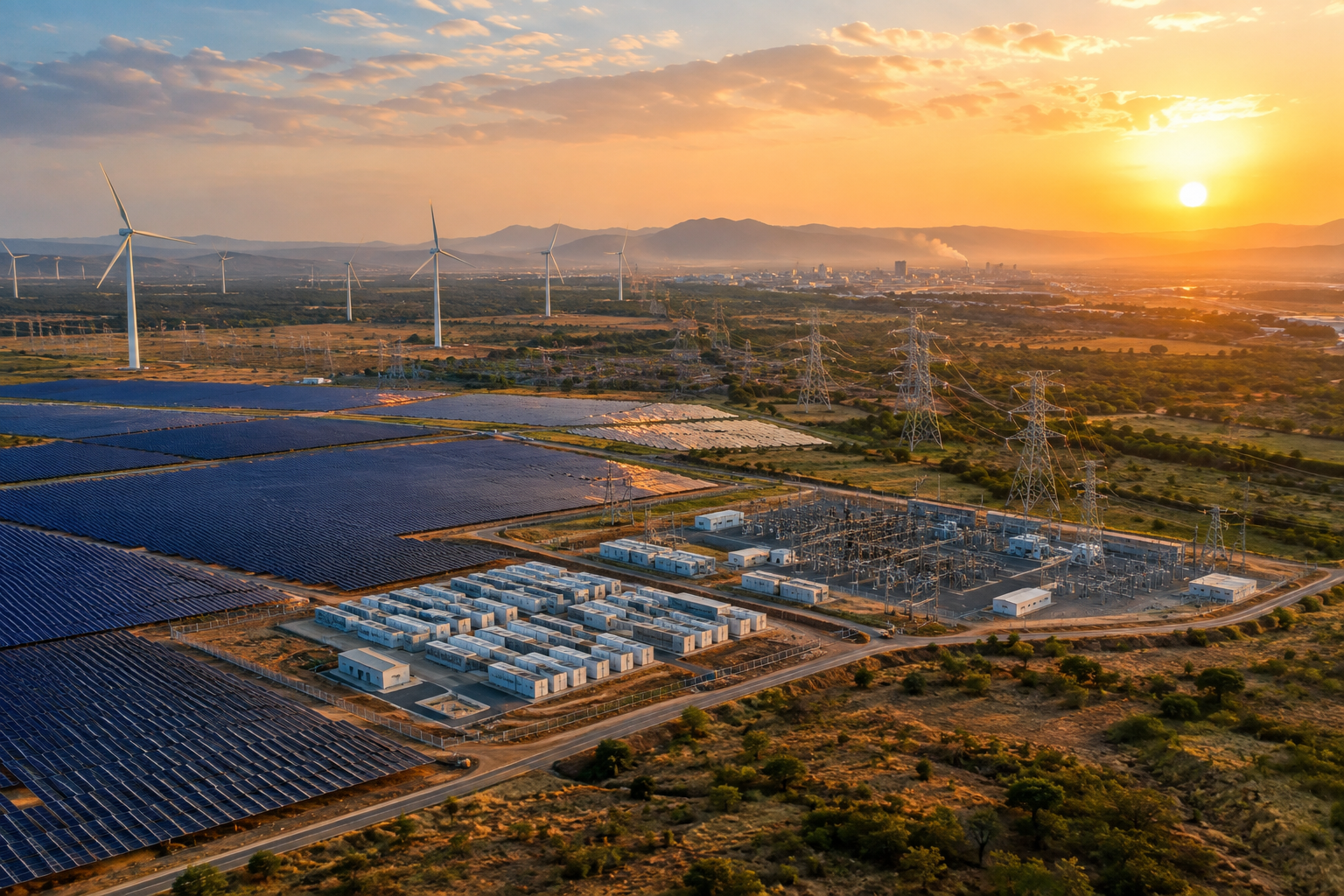
The emerging energy system therefore needs to be viewed as an integrated architecture:
Renewable generation + transmission + storage + flexibility + intelligent grid management.
The Bigger Opportunity for India’s Energy Transition
The bottleneck identified by Ember also represents an opportunity.
If India can deploy sufficient flexibility alongside renewable generation, more of the country’s solar and wind output can be utilised rather than curtailed.
That could improve the economics of renewable projects while reducing wasted clean electricity.
It could also accelerate the transition toward a more flexible electricity system capable of supporting:
- Large-scale solar and wind
- Round-the-clock renewable power
- Green-energy procurement for industry
- Renewable-powered data centres
- Electric mobility
- Green hydrogen
- Commercial and industrial decarbonisation
In this environment, BESS increasingly moves from being an optional addition to renewable projects toward becoming core grid infrastructure.
Conclusion
India’s renewable-energy transition is entering a new phase.
The first phase was dominated by the rapid addition of solar and wind capacity. The next phase will depend increasingly on the country’s ability to integrate, balance and utilise that generation effectively.
Ember’s analysis highlights a critical warning: if the flexibility of conventional generation cannot keep pace with renewable growth, renewable curtailment could become a more significant constraint.
Battery storage offers one important solution by absorbing surplus renewable electricity, providing flexibility and shifting energy toward periods of higher demand.
But storage must be supported by the right connectivity framework, transmission infrastructure, forecasting, market mechanisms and complementary flexibility resources.
India’s next renewable-energy milestone may therefore not simply be another gigawatt of capacity. It may be how efficiently the grid can use every clean-energy unit that India produces.