 openaccessexchange@gmail.com
 Mon - Fri: 9 AM to 8 PM


Wind, Hybrids, and the 500 GW Goal: Inside India's Most Ambitious Energy Bet
India’s energy challenge is one of the most complex in the world — and one of the most consequential. A population of over 1.4 billion people, an economy growing faster than almost any other on the planet, and an industrial base that is actively expanding its ambitions as a global manufacturing hub — all of it requires power. Vast, reliable, affordable power, delivered consistently to homes, factories, hospitals, data centres, and schools across a geography the size of a subcontinent.
For decades, coal was the answer India reached for. It was abundant, relatively cheap, and the infrastructure to use it already existed. The cost of that answer — in air quality, in carbon emissions, in the long-term health of the population, and increasingly in the financial burden of importing fuel at the mercy of international commodity markets — has been building for years. The recognition that coal cannot be the answer India reaches for indefinitely is now embedded in national policy in a way that would have been difficult to imagine a generation ago.
India’s target of 500 gigawatts of clean energy capacity by 2030 is the most concrete expression of that recognition. It is an ambitious number — one that requires not just the continued expansion of solar power, which has grabbed most of the headlines, but the rapid scaling of wind energy and the emergence of hybrid systems that combine multiple renewable sources into something more reliable and flexible than any single source can provide alone.
Where India Stands on Wind — and Why the Foundation Is Stronger Than Many Realise
India is already among the top five countries in the world for installed wind energy capacity. That position was not achieved overnight — it is the result of decades of development across states that have the geographic conditions to support large-scale wind generation. Tamil Nadu, Gujarat, Rajasthan, Maharashtra, Karnataka, and Andhra Pradesh all have the combination of open land, consistent wind speeds, and grid connectivity that makes them natural homes for wind farms.
The turbines operating across these states today are not the modest installations of the early renewable energy era. Modern wind turbines are engineering achievements in their own right — towers rising 120 metres or more above the ground, with blades spanning lengths that dwarf anything built a decade ago, designed to capture energy from wind speeds and altitudes that earlier technology could not access. The electricity they generate at ₹2.5 to ₹3.5 per unit — competitively tendered and verified — is among the most affordable power available in India today.
For industrial businesses sourcing energy through open access arrangements, wind power’s cost profile makes it a compelling option, particularly in states where wind resources are strong and the regulatory framework for open access procurement is mature. The fixed tariff available through a long-term wind PPA offers the same price stability as solar — but with a generation profile that often complements solar particularly well through different seasons and times of day.
Offshore Wind: India’s Next Frontier
If onshore wind in India represents a maturing success story, offshore wind represents the next chapter — one that is still being written but that holds the potential to add genuinely transformative scale to the country’s renewable capacity.
India’s coastline stretches for more than 7,500 kilometres. The seas off the coasts of Gujarat and Tamil Nadu, in particular, experience wind speeds that are consistently higher and more reliable than most onshore sites — because there are no hills, buildings, or terrain features to disrupt the flow of air across open water. Offshore turbines can also be built larger than their onshore counterparts, with fewer constraints on blade size and tower height, making them capable of generating significantly more electricity per installation.
The Indian government has identified offshore wind development as a strategic priority, with initial projects planned along the Gujarat and Tamil Nadu coasts. The economics of offshore wind in India are still maturing — offshore development costs more per megawatt than onshore, and the supply chain for offshore installation and maintenance is less developed domestically — but the trajectory of costs in offshore markets globally has been consistently downward, and India’s offshore programme is being designed to benefit from the experience and technology improvements that European and Asian markets have already generated.
The scale of potential offshore wind capacity along India’s coasts is large enough that its eventual contribution to the 500 GW target — and to the long-term energy system that India builds beyond 2030 — could be substantial.
Hybrid Systems: Where the Real Reliability Breakthrough Is Happening
The single most important innovation in India’s renewable energy development right now is not a new technology — it is a new way of combining technologies that already exist.
Wind energy and solar energy have complementary generation profiles. Solar produces most of its output during daylight hours, with peak generation in the middle of the day. Wind generation in India frequently peaks at different times — often in the evening and night, and during monsoon periods when cloud cover reduces solar output significantly. Neither source, on its own, provides the round-the-clock reliability that industrial consumers require.
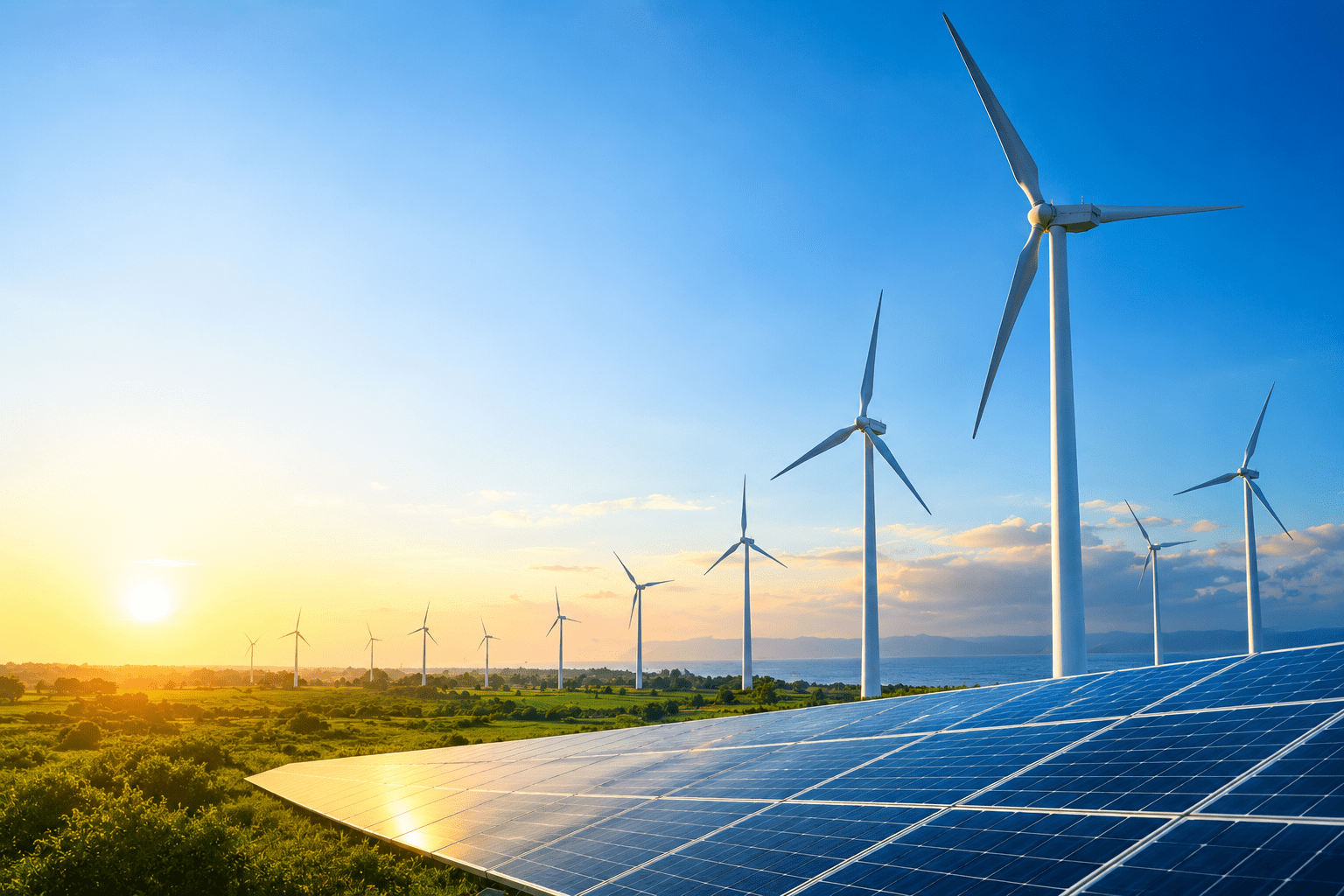
Hybrid plants — facilities that co-locate solar panels and wind turbines on the same site, sharing grid connection infrastructure and often incorporating battery storage as well — produce a generation profile that is more consistent and balanced than either source alone. The gaps in solar output are partially filled by wind. The gaps in wind output are partially filled by solar. Battery storage absorbs surplus from whichever source is generating and dispatches it when both are running below demand.
The practical result, for businesses procuring power from hybrid projects through open access arrangements, is a supply profile that is more stable and predictable across seasons and times of day — with the cost advantages of renewable energy and without the reliability concerns that pure solar or pure wind procurement can raise.
Hybrid renewable projects are now being tendered and developed at scale across India’s best resource states. They represent the direction that large-scale renewable procurement is moving — and for industrial businesses evaluating open access options, hybrid projects are increasingly the most attractive commercial proposition available.
The Broader Impact: Jobs, Independence, and Inclusion
India’s push toward wind and hybrid renewable energy is generating value that extends well beyond the electricity it produces and the carbon emissions it avoids.
The renewable energy sector has become a significant source of employment across the skills spectrum — from the engineers designing next-generation turbines and the data analysts managing plant performance systems, to the installation workers, maintenance technicians, and logistics professionals whose livelihoods are tied to the physical work of building and running the country’s clean energy infrastructure. As India’s renewable capacity scales toward the 500 GW target, the employment supported by the sector will scale with it.
Reducing dependence on imported coal and fuel oil through the expansion of domestically generated renewable power has direct implications for India’s energy security and its foreign exchange position. Every gigawatt of wind or solar capacity that displaces coal-based generation is a reduction in the fuel import bill that has historically made India’s electricity costs vulnerable to geopolitical events and commodity market movements far beyond its control.
And in the remote and rural communities where wind farms are increasingly being developed — particularly in states like Rajasthan and Madhya Pradesh — the arrival of large renewable projects brings employment, infrastructure, and economic activity to areas that have historically been peripheral to India’s growth story. The landowners who lease their land, the workers who build and maintain the installations, and the communities whose local economies benefit from the presence of long-term industrial investment are all part of the value that wind energy creates beyond its kilowatt-hours.
What This Means for Your Business’s Energy Strategy
For commercial and industrial businesses thinking about their long-term energy procurement, India’s wind and hybrid energy expansion is directly relevant — and the time to act on that relevance is now.
Open access to wind power and hybrid renewable projects is already available in India’s key industrial states, through long-term power purchase agreements that offer competitive tariffs, price stability for the life of the contract, and verified clean energy credentials that satisfy ESG reporting requirements. The development pipeline of wind and hybrid projects across Tamil Nadu, Gujarat, Rajasthan, Karnataka, and Andhra Pradesh means that supply is available, competitive, and expandable as your business’s needs grow.
Businesses that establish wind or hybrid open access agreements in the current market are locking in rates and structures that will look increasingly advantageous as the sector matures and India’s 500 GW target comes within reach. The policy environment is supportive. The technology is proven. The economics are compelling.
At Open Access Energy, we help businesses understand and access wind and hybrid renewable power through open access arrangements tailored to their specific consumption profile and strategic goals. We navigate the market, the regulation, and the commercial structures so that your business can benefit from India’s clean energy expansion without having to become an energy expert to do so.
Reach out to Open Access Energy today — and let’s talk about how wind and hybrid power fits into the energy future your business needs to build.