 openaccessexchange@gmail.com
 Mon - Fri: 9 AM to 8 PM


MNRE Draft Raises Efficiency and Safety Standards for Solar Pump Controllers
 August 14, 2026
India’s solar-powered agriculture sector could see a significant technology upgrade following a new draft from the Ministry of New and Renewable Energy (MNRE) proposing revised specifications for solar photovoltaic water-pumping controllers.
The draft, prepared by the National Institute of Solar Energy (NISE), introduces higher efficiency requirements along with wider PV operating ranges, multifunctional applications, battery storage integration, remote monitoring and grid-interactive capabilities. Stakeholders have been invited to submit comments on the draft until August 28, 2026.
One of the major proposed changes is the expansion of the PV input operating range. Controllers would need to deliver rated power while operating at nominal PV voltage as well as at 15% below and 15% above nominal voltage.
For systems rated at 10 kVA and above, the draft proposes multi-channel Maximum Power Point Tracking (MPPT). This is intended to reduce PV mismatch losses and improve energy harvesting from solar modules.
The proposed specifications also introduce stricter efficiency requirements.
Static MPPT efficiency would need to reach at least 98% across 10%-100% of rated PV input power, while dynamic MPPT efficiency would need to reach at least 97%.
The proposed overall system efficiency is 90.2% for controllers below 5 HP and 91.2% for controllers rated at 5 HP or above.
The draft goes beyond conventional agricultural pumping.
Future solar pump controllers could potentially supply power not only to irrigation pumps but also to other farm equipment and household loads.
The proposed configuration includes two three-phase 400 V outputs and two single-phase 220 V outputs, with compatibility across induction, PMSM and BLDC motors.
Battery energy storage is another important addition.
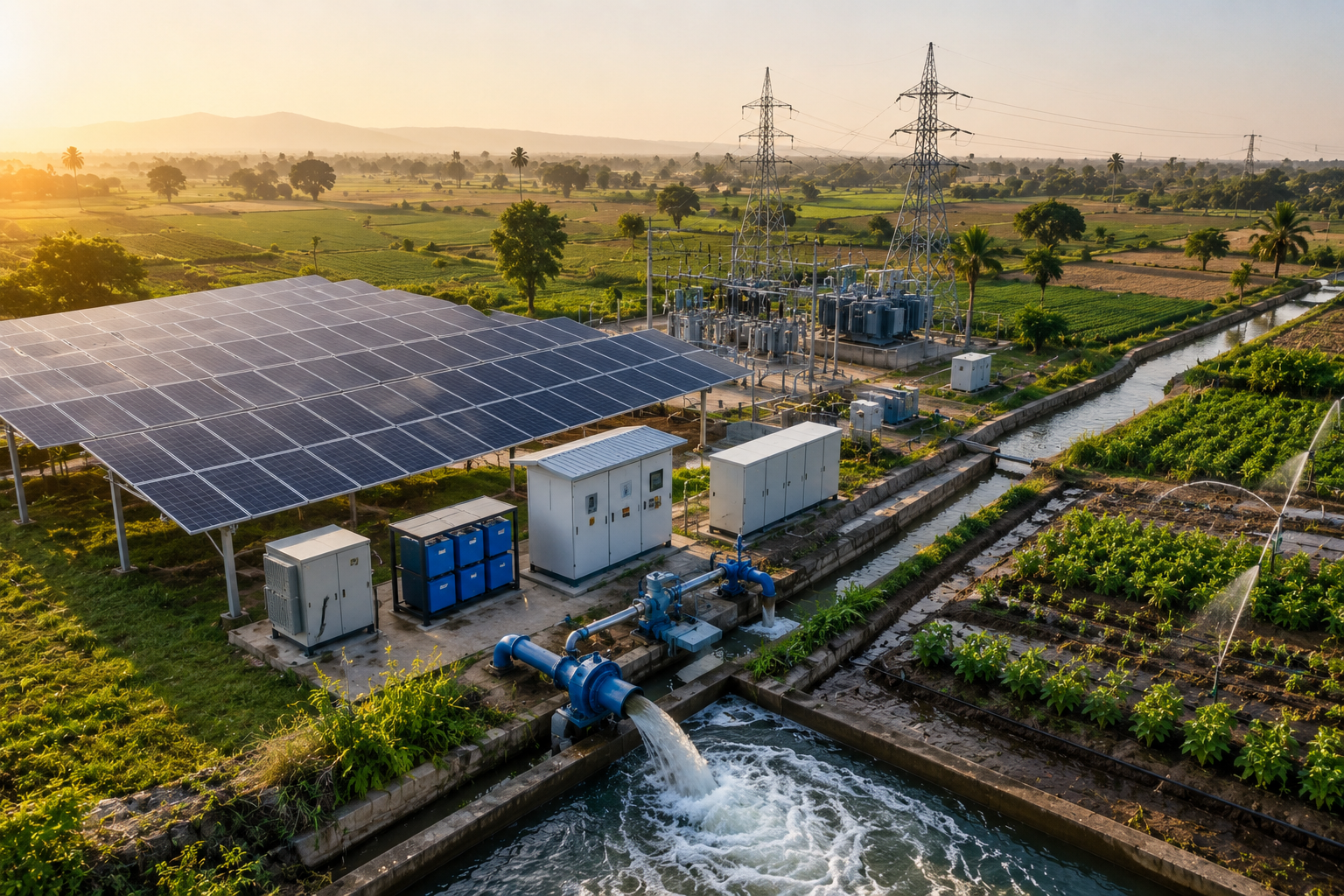
The proposed framework would allow dedicated battery storage systems to capture surplus solar energy and make it available during periods of low solar generation or at night.
Hybrid systems could also import electricity from the grid when solar generation and stored energy are insufficient. Conversely, surplus solar electricity could be exported when local demand is lower, subject to applicable regulations.
The draft also strengthens digital monitoring and protection requirements.
Controllers would include GSM/GPRS-based remote monitoring and geo-tagging, allowing parameters such as solar generation, pump operating hours and water discharge to be monitored remotely.
For agricultural operating environments, proposed protections include IP6X dust protection, IPX5 water protection, humidity testing at 92% relative humidity and 40°C, and electrical surge protection.
The proposed standards indicate a broader shift in how solar pumping systems are being designed.
Instead of functioning purely as solar-powered irrigation equipment, future systems could operate as integrated energy platforms combining solar generation, intelligent power conversion, battery storage, farm loads, digital monitoring and grid connectivity.
This could improve the utilisation of installed solar assets while giving farmers greater flexibility in how renewable electricity is used.
The proposed framework also reflects the wider digitalisation of India’s renewable-energy ecosystem, where intelligent controllers, energy storage and remote monitoring are becoming increasingly important.
If adopted, the new specifications could push solar pump technology towards higher efficiency, greater flexibility and smarter energy management.