 openaccessexchange@gmail.com
 Mon - Fri: 9 AM to 8 PM


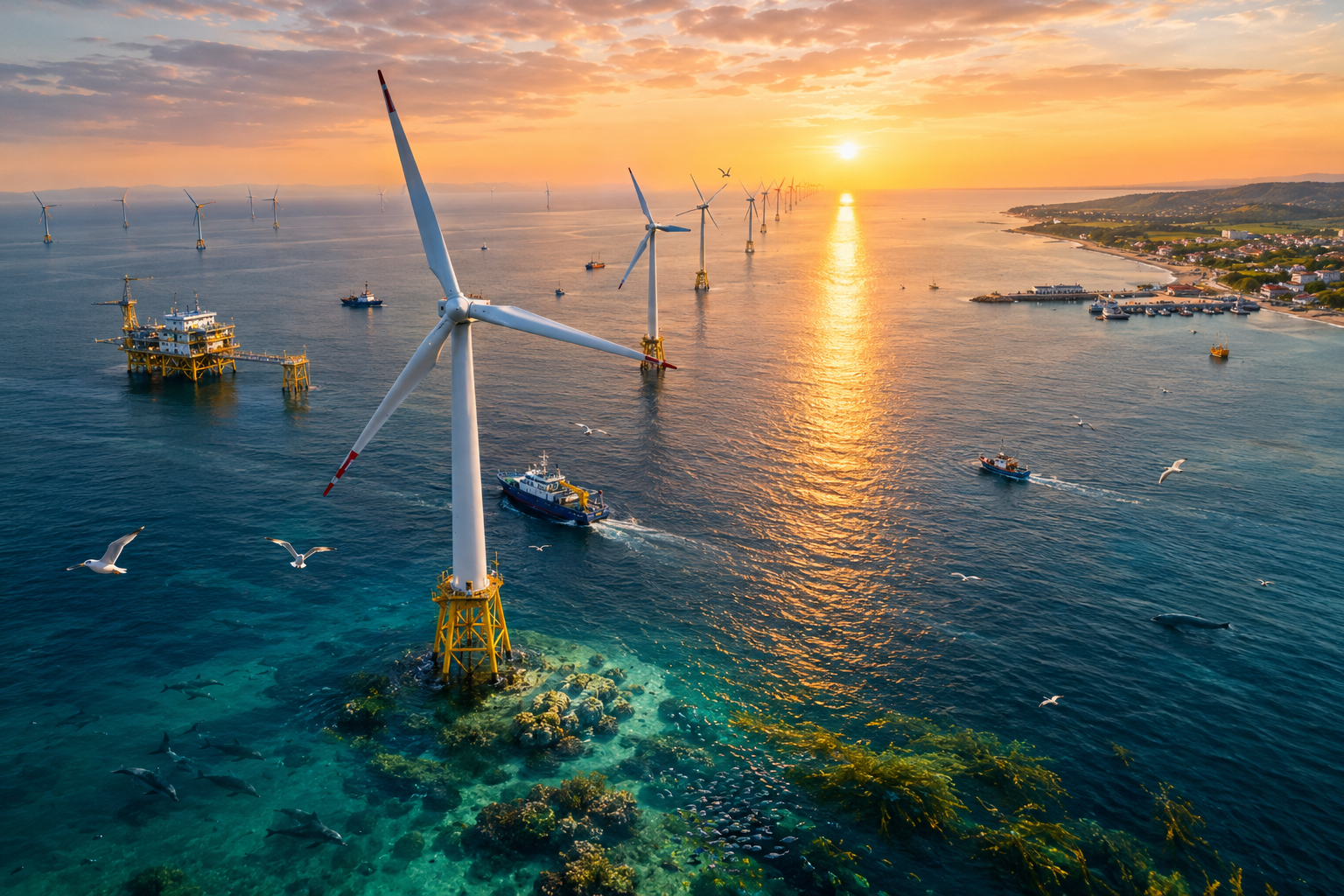
Greening Offshore Wind: Balancing Clean Energy Growth with Marine Conservation
Offshore wind is emerging as an important pillar of the global clean-energy transition. But as the industry expands, a new question is becoming increasingly important:
Can offshore wind deliver climate benefits while also protecting the oceans that host it?
Mongabay’s latest reporting explores promising approaches for reducing the environmental footprint of offshore wind, from better project siting and nature-inclusive engineering to recyclable turbine components and habitat restoration.
1. Start with ecosystem-based marine spatial planning
Where an offshore wind farm is built can be as important as how it is built.
Marine spatial planning can map fisheries, shipping routes, sensitive habitats, seabird populations and other ocean uses before projects are approved. Experts cited by Mongabay describe careful site selection as one of the most effective ways to avoid environmental impacts in the first place.
The principle is straightforward:
Avoid sensitive ecosystems before trying to mitigate damage later.
2. Use biodiversity data to guide turbine locations
Offshore wind development can overlap with important habitats for seabirds and other marine species.
Sensitivity maps and ecological datasets can help developers identify areas where turbines could create greater biodiversity risks. Mongabay highlights the need for stronger international collaboration and better integration of such information into planning decisions.
As offshore wind expands beyond Europe into Asia and Latin America, filling these data gaps will become increasingly important.
3. Make turbine foundations more nature-friendly
Offshore wind foundations inevitably alter the seabed.
But engineering design can potentially make these structures more compatible with marine ecosystems. Foundation and scour-protection structures can be designed to provide surfaces for marine organisms, effectively creating artificial-reef environments.
Research cited by Mongabay has found that offshore wind farms can sometimes provide refuge for fish, crustaceans and other species, particularly where fishing activity is restricted.
4. Explore habitat restoration around wind farms
One particularly promising approach is to use offshore wind infrastructure as a platform for marine restoration.
Mongabay highlights trials in the North Sea involving oyster larvae attached to stones used for scour protection around turbine foundations. The objective is to explore whether offshore infrastructure can contribute to restoring depleted oyster reefs.
However, experts caution that biodiversity improvements should not be treated as a substitute for avoiding ecological damage.
5. Reduce underwater construction noise
Construction activities can generate underwater noise that affects marine life.
One mitigation approach is the use of bubble curtains, which can reduce underwater sound generated during foundation installation. Other acoustic mitigation technologies are also being tested.
As offshore wind projects move into deeper waters and use larger foundations, managing construction impacts will become increasingly important.
6. Develop greener materials and corrosion protection
Offshore infrastructure requires extensive protection against corrosion.
But some conventional corrosion-protection systems can introduce metals into surrounding waters. Mongabay cites research showing releases of metals including aluminum, zinc and indium from European offshore wind farms.
This creates an opportunity for alternative corrosion-protection technologies and materials that reduce environmental releases.
7. Make turbine blades more recyclable
Wind-turbine blades are among the more difficult components to recycle because of their composite materials.
The offshore industry is therefore exploring recyclable blade technologies and alternative materials to reduce waste at the end of turbine life. The latest Mongabay article specifically identifies recyclable blades among the approaches being pursued to make offshore wind greener.
As turbine sizes increase, improving end-of-life management could become increasingly important.
8. Monitor cables, anchors and marine interactions
Floating offshore wind introduces additional considerations because platforms are connected to the seabed through mooring systems and cables.
Potential risks include interactions with marine wildlife, cable entanglement and changes to seabed conditions. Appropriate cable design, continuous monitoring and emergency-response plans can help manage these risks.
This will become especially relevant as floating wind expands into deeper waters.
9. Improve understanding of ocean and ecosystem impacts
One of the biggest challenges is that offshore wind is scaling faster than the scientific understanding of some of its cumulative effects.
Mongabay reports that a 2025 paper found 86% of possible ecosystem-service impacts remain unknown, while long-term data covering the entire operational life of wind farms remains limited. Research outside Europe is particularly sparse.
Future projects therefore need stronger environmental monitoring before, during and after construction.
10. Put environmental criteria into project auctions
Cost should not be the only factor determining which offshore wind projects move forward.
Mongabay reports that some European auctions, including those in the Netherlands and France, have used non-price criteria to encourage developers to incorporate environmental solutions.
Such criteria could reward:
- Biodiversity protection
- Nature-inclusive engineering
- Recyclable components
- Lower construction impacts
- Community engagement
- Environmental monitoring
- Habitat restoration
This could create commercial incentives for developers to compete on environmental performance as well as electricity price.
Offshore wind needs a different development model
The environmental discussion around offshore wind is becoming more sophisticated.
Offshore wind farms can have both positive and negative ecological effects. They can restrict harmful activities such as bottom trawling and create artificial-reef structures, while construction and operation can also affect birds, bats, marine mammals, sediment movement and ocean dynamics.
Some emerging impacts remain uncertain. Research discussed by Mongabay suggests that large wind farms could influence sediment transport, ocean stratification, surface temperatures and marine circulation, although scientists emphasize that the consequences are not yet fully understood and depend strongly on location.
That uncertainty makes long-term monitoring and adaptive management particularly important.
The future: clean energy that works with nature
The offshore wind industry is expanding at a time when oceans are already under pressure from fishing, shipping, climate change, pollution and other human activities.
The opportunity is therefore to build an industry that does more than simply minimise damage.
The emerging model is:
Avoid sensitive areas → minimise construction impacts → design for biodiversity → monitor ecosystems → restore habitats where possible → involve coastal communities.
This approach can help offshore wind become part of a broader nature-positive energy transition, rather than treating climate and biodiversity as separate objectives.
Conclusion
Offshore wind has enormous potential to contribute to global decarbonisation, but its long-term success will depend on how responsibly the industry interacts with marine ecosystems.
Better spatial planning, nature-friendly foundations, quieter construction, recyclable components, improved corrosion protection, habitat restoration, environmental monitoring and stronger auction criteria can all help reduce the industry’s ecological footprint.
But there is no single technological fix.
The next generation of offshore wind will need to be designed not only for stronger winds and lower electricity costs, but also for healthier oceans.