 openaccessexchange@gmail.com
 Mon - Fri: 9 AM to 8 PM


The Growing Role of Automation in Solar, Wind and Hydropower Operations
India’s renewable-energy sector is expanding rapidly, and the increasing scale and complexity of renewable assets are creating a growing need for smarter operations.
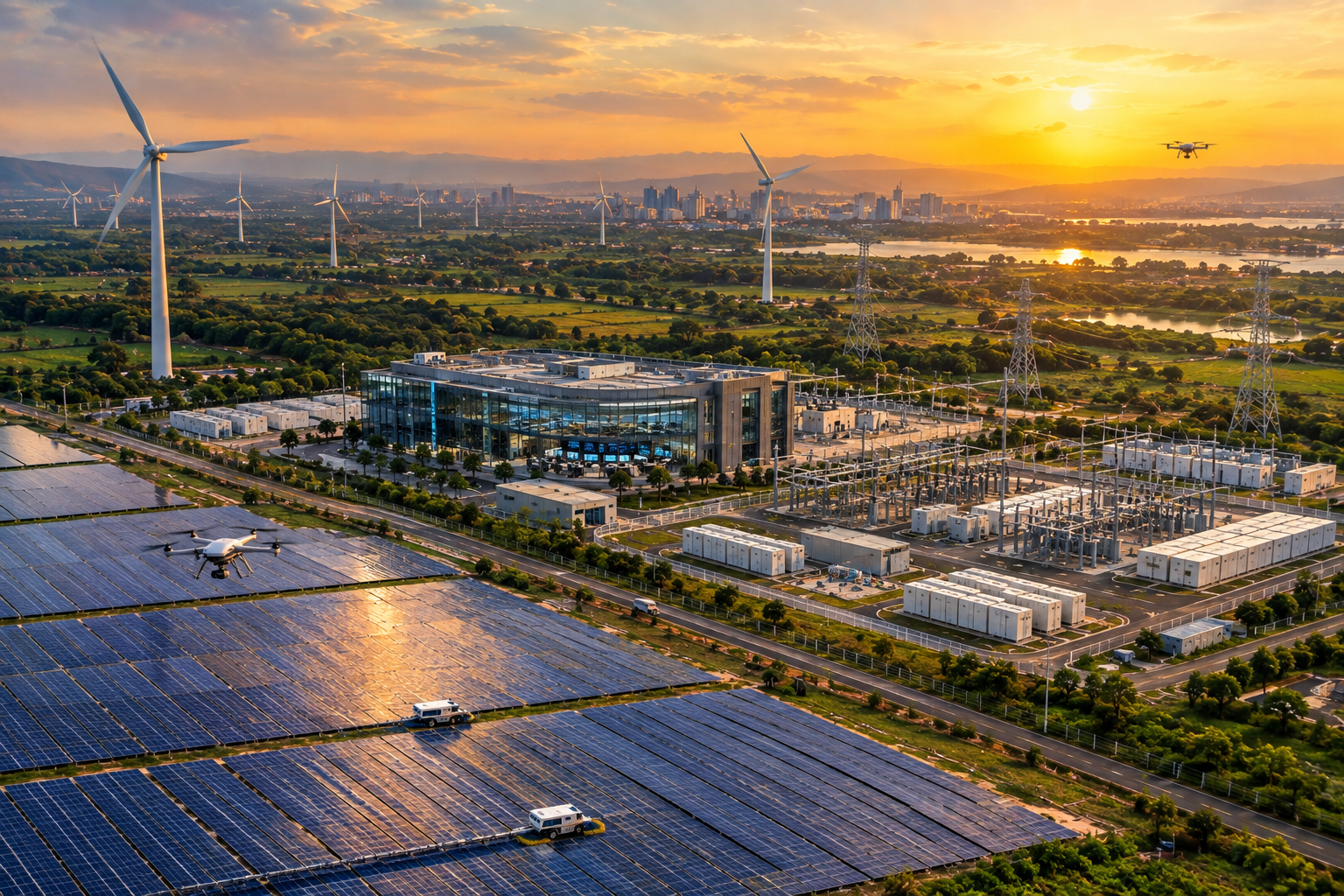
Automation is becoming an important part of this transformation. From SCADA and programmable logic controllers to AI, IoT sensors, drones, robotics and digital twins, renewable-energy operators are increasingly using digital technologies to monitor assets, predict failures, improve generation forecasts and manage plants remotely.
From mechanisation to intelligent operations
Power-plant automation has evolved from basic mechanisation toward highly connected digital systems.
Modern renewable facilities can collect large volumes of operational data and use automated systems to monitor equipment and plant conditions in real time. Centralised platforms can also enable operators to monitor and remotely manage renewable assets across multiple locations.
This can help reduce downtime, lower operational losses and improve overall plant performance.
Hydropower: Automation beyond generation
Hydropower plants are increasingly using automation to optimise water utilisation and electricity generation.
Automated systems can monitor:
- Water levels
- Flow rates
- Electricity demand
- Turbine performance
- Vibration
- Pressure
- Temperature
- Grid conditions
Automated turbine governors can adjust turbine speed and output according to grid frequency, load, water availability and electricity demand. Automation can also improve dispatch scheduling and gate-control operations.
Digital monitoring is also extending into dam safety. IoT sensors, drones and AI-supported video analytics can monitor seepage, structural movement, inclination and seismic activity.
Underwater robotic systems equipped with sonar can support inspection of submerged or difficult-to-access infrastructure.
AI is strengthening predictive maintenance
One of the biggest advantages of digitalisation is the ability to identify abnormal behaviour before it develops into a major equipment failure.
AI can analyse large datasets from sensors and operational equipment to identify patterns that may not be immediately visible through manual inspection.
This moves renewable operations from a reactive maintenance model toward predictive and condition-based maintenance.
For large renewable portfolios, this can be particularly valuable because operators may be managing hundreds of turbines, thousands of inverters and geographically dispersed solar installations.
Solar plants are becoming increasingly automated
Automation is influencing almost every stage of solar-project development.
During construction, AI can support project planning and logistics, while drones can assist with surveying and construction monitoring. Computer vision can also identify installation defects and wiring problems.
During operations, IoT sensors can continuously monitor parameters such as:
- Solar irradiance
- Temperature
- Humidity
- Panel performance
- Inverter performance
- Tracker operation
- Weather conditions
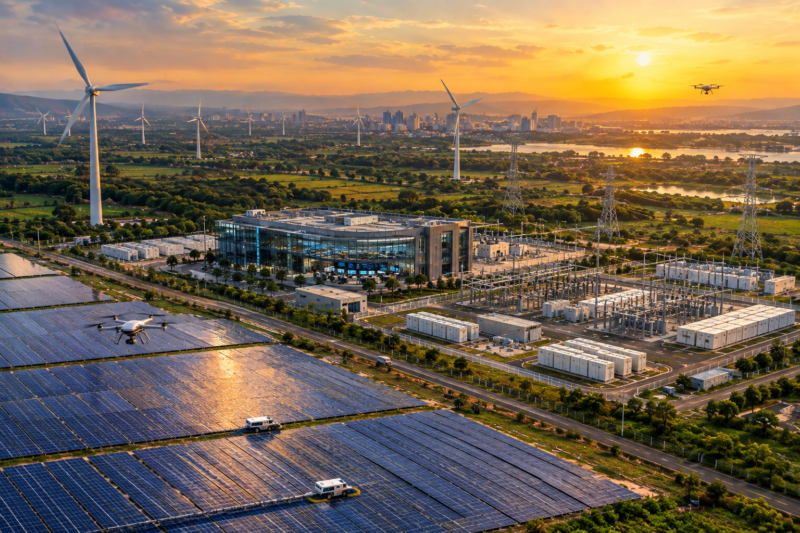
Integrated monitoring platforms can bring information from panels, inverters, trackers, weather stations and substations into a central operating environment.
Drones and AI are changing solar inspection
Thermal-imaging drones can identify hotspots, diode failures and other potential equipment problems much faster than traditional manual inspection.
AI-based forecasting systems can combine historical generation data, meteorological information and real-time weather conditions to improve solar-output predictions.
Cloud-imaging systems and sky cameras can also help operators understand approaching cloud movements and anticipate short-term changes in generation.
Another emerging application is automated panel cleaning. Robotic cleaning systems can optimise cleaning schedules according to dust accumulation and weather conditions while potentially reducing water consumption.
Wind energy is becoming more intelligent
Modern wind turbines already use automated systems to continuously monitor wind speed, direction, temperature and turbine performance.
AI-enabled asset-management platforms can analyse this information to support predictive maintenance and reduce unexpected outages.
Automated control systems can also adjust blade position and turbine rotation according to changing weather conditions, while advanced controls can help reduce wind-shadow effects and correct yaw misalignment.
Sensors monitoring rotor speed, blade pitch and nacelle orientation can identify unusual vibration, overheating and potential blade damage.
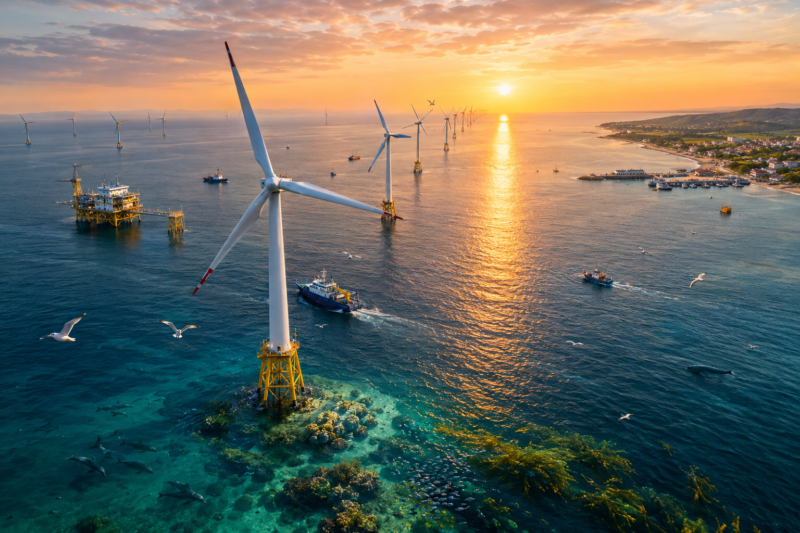
These capabilities become especially valuable for offshore wind projects, where inspection and maintenance can be considerably more difficult and expensive.
Digital twins could become the next operational layer
Digital twins are emerging as an important tool for renewable-energy asset management.
A digital twin creates a virtual representation of equipment using real-time operational data. Operators can use these models to:
- Detect abnormal behaviour
- Evaluate equipment performance
- Simulate operating conditions
- Test different scenarios
- Optimise plant performance
- Improve maintenance planning
For large renewable portfolios, digital twins could eventually provide a common digital environment for understanding the health and performance of assets across an entire fleet.
Automation is becoming critical as renewable portfolios scale
The significance of automation extends beyond individual solar or wind plants.
As renewable portfolios become larger and more geographically distributed, manual monitoring becomes increasingly difficult.
Digital platforms can allow operators to move from managing individual assets toward portfolio-level optimisation.
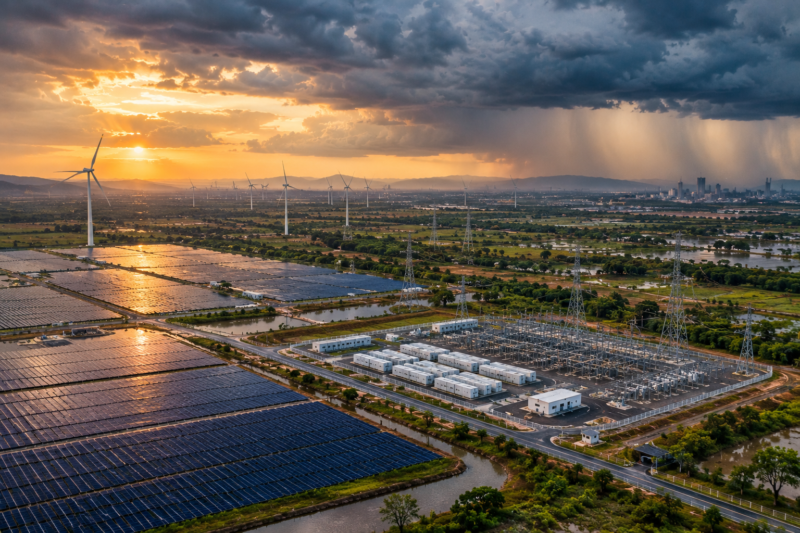
This is particularly important as renewable projects increasingly operate alongside BESS, hybrid generation, advanced inverters and sophisticated grid-management systems.
The broader digitalisation trend is also moving toward AI-based performance analysis, grid-forming technologies and greater system flexibility across renewable and storage assets.
The business case goes beyond efficiency
Automation is not simply a technology upgrade.
It can influence the economics of renewable projects through:
Higher availability → fewer unexpected outages → better generation → improved asset utilisation → lower O&M costs.
At the same time, better forecasting and monitoring can help renewable operators manage variability and participate more effectively in increasingly sophisticated electricity markets.
Conclusion
India’s renewable-energy transition is entering a phase where digital intelligence will be as important as physical generation capacity.
Solar panels, wind turbines and hydropower equipment generate electricity—but automation, AI, sensors, robotics and digital twins increasingly determine how efficiently those assets operate.
As renewable capacity continues to scale, the winning projects may not simply be those with the lowest generation cost. They may increasingly be the projects capable of combining clean generation with intelligent monitoring, predictive maintenance, accurate forecasting and automated control.
The next evolution of renewable energy is therefore not just about generating more power—it is about making every megawatt smarter.